
Sage 100 vs Sage 300 Hosting: Which ERP Cloud Solution Is Better in 2026?
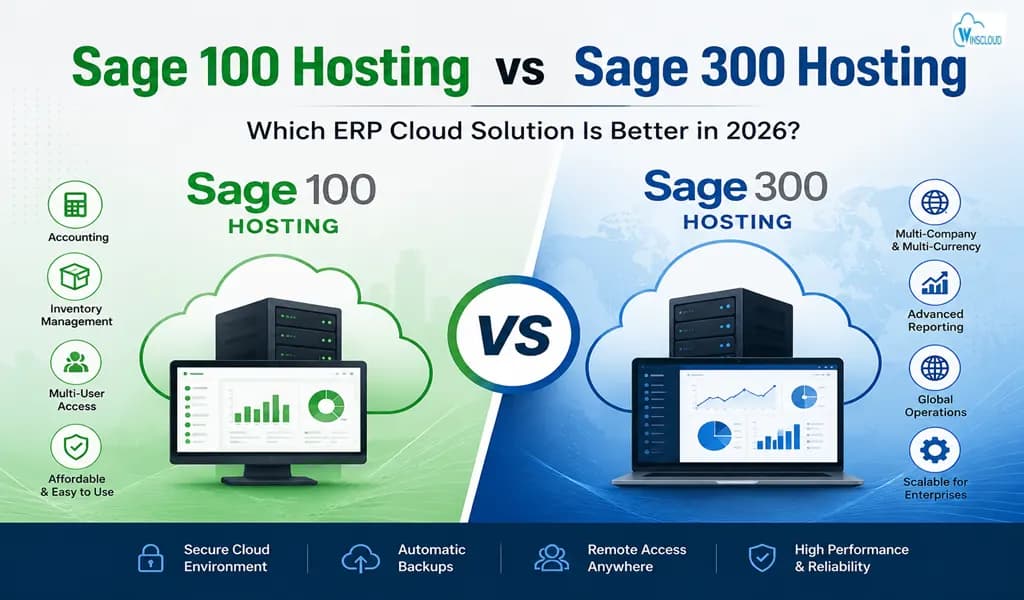
Businesses looking to modernize their accounting and ERP infrastructure often compare Sage 100 Hosting and Sage 300 Hosting before moving to the cloud. While both ERP solutions are powerful, they are designed for different business sizes, operational complexities, and scalability requirements.
In this guide, we compare Sage 100 Hosting vs Sage 300 Hosting based on features, deployment, pricing, scalability, multi-user access, reporting, and cloud performance to help you choose the right ERP hosting solution for your business in 2026.
What Is Sage 100 Hosting?
Sage 100 hosting refers to running Sage 100 software on a secure cloud server instead of installing it locally on office computers. Hosted Sage 100 allows users to access accounting, inventory, payroll, and business management tools remotely through the internet.
Sage 100 is mainly designed for small to medium-sized businesses that need advanced accounting with moderate operational complexity.
Key Features of Sage 100 Hosting
- Remote access from any device
- Multi-user collaboration
- Automated cloud backups
- Inventory and warehouse management
- Financial reporting tools
- Payroll integration
- Secure cloud infrastructure
- Reduced IT maintenance costs
What Is Sage 300 Hosting?
Sage 300 Hosting enables businesses to run Sage 300 ERP on cloud servers for better accessibility, scalability, and enterprise-level performance.
Sage 300 is built for mid-sized to large businesses with complex accounting operations, multiple entities, international transactions, and advanced workflow requirements.
Key Features of Sage 300 Hosting
- Multi-company and multi-currency support
- Enterprise-level financial management
- Advanced inventory control
- International business management
- Project and job costing
- Flexible business intelligence reporting
- Remote team collaboration
- High scalability for growing enterprises
Sage 100 Hosting vs Sage 300 Hosting: Major Differences
| Feature | Sage 100 Hosting | Sage 300 Hosting |
| Business Size | Small to Medium Businesses | Medium to Large Enterprises |
| Scalability | Moderate | High |
| Multi-Currency Support | Limited | Advanced |
| Multi-Entity Management | Basic | Enterprise-Level |
| Reporting Capabilities | Standard Reporting | Advanced Business Intelligence |
| Inventory Management | Good | Advanced & Complex |
| International Operations | Limited | Strong Support |
| Customization | Moderate | Extensive |
| Deployment Complexity | Easier | More Advanced |
| Ideal Users | SMBs | Enterprises & Growing Companies |
Which Businesses Should Choose Sage 100 Hosting?
Sage 100 Hosting is ideal for companies that need strong accounting software without enterprise-level complexity.
Best For
- Retail businesses
- Small manufacturing firms
- Wholesale distributors
- Local service companies
- SMBs with limited IT teams
Advantages of Sage 100 Hosting
Affordable ERP Hosting: Sage 100 Hosting generally costs less compared to enterprise ERP hosting solutions, making it suitable for budget-conscious businesses.
Easy Implementation: Businesses can migrate to hosted Sage 100 with minimal technical complexity and reduced downtime.
Simplified Accounting Operations: The platform provides essential accounting, inventory, payroll, and reporting tools without overwhelming smaller teams.
Remote Workforce Accessibility: Employees can securely access Sage 100 from home, office, or remote locations.
Which Businesses Should Choose Sage 300 Hosting?
Sage 300 Hosting is designed for businesses managing complex operations across departments, branches, or countries.
Best For
- Large distributors
- Multi-location companies
- International businesses
- Enterprises with complex accounting
- Growing organizations requiring scalability
Advantages of Sage 300 Hosting
Advanced Multi-Company Management: Sage 300 supports multiple business entities under one ERP environment.
Better Scalability: The software easily adapts as businesses expand operations, users, and transaction volumes.
Enterprise Reporting & Analytics: Sage 300 provides advanced financial insights and customizable reporting tools for decision-making.
Global Business Support: Multi-currency and international tax capabilities make Sage 300 suitable for global operations.
Sage 100 Hosting vs Sage 300 Hosting: Performance Comparison
Cloud Accessibility
Both Sage 100 Hosting and Sage 300 Hosting provide secure cloud access, allowing users to work from anywhere with an internet connection. This flexibility improves productivity and supports remote and hybrid work environments.
Security
Hosted environments for both ERP solutions typically include advanced security measures such as data encryption, multi-factor authentication, firewall protection, and regular backups. These features help protect sensitive financial and business information from cyber threats.
Multi-User Experience
Sage 100 Hosting performs well for small to medium-sized teams, offering smooth collaboration among users. Sage 300 Hosting is better equipped to handle larger organizations with higher numbers of concurrent users and complex workflows.
Speed and Reliability
The performance of both solutions largely depends on the quality of the hosting provider and server infrastructure. With SSD-powered cloud servers and high-uptime environments, users can expect fast access speeds and reliable ERP performance.
Scalability
Sage 100 Hosting supports business growth but is generally suited for moderate expansion. Sage 300 Hosting offers greater scalability, making it ideal for organizations managing multiple entities, locations, and increasing transaction volumes.
System Integration
Both hosted ERP solutions can integrate with various third-party applications and business tools. However, Sage 300 Hosting typically offers more advanced integration capabilities for enterprises with complex operational requirements.
Data Management
Sage 100 Hosting efficiently manages accounting, inventory, and operational data for SMBs. Sage 300 Hosting is designed to handle larger datasets and more sophisticated reporting requirements across multiple business units.
Business Continuity
Cloud hosting ensures automatic backups and disaster recovery options for both platforms. In the event of hardware failure or unexpected disruptions, businesses can quickly restore access to their ERP data and continue operations.
Benefits of Hosting Sage ERP on Cloud
Reduced IT Costs: Cloud hosting removes the need for expensive in-house servers and maintenance.
Work From Anywhere: Teams can securely access ERP systems remotely.
Automatic Backups: Most hosting providers offer daily backups and disaster recovery.
Better Collaboration: Employees across multiple locations can work in the same ERP environment simultaneously.
Improved Security: Professional hosting providers implement enterprise-grade cybersecurity measures.
Final Thoughts
Both Sage 100 Hosting and Sage 300 Hosting provide secure cloud access, remote collaboration, and improved ERP flexibility. The right choice depends on your business size, operational complexity, growth plans, and budget.
Sage 100 Hosting works best for SMBs seeking affordable cloud ERP solutions, while Sage 300 Hosting is better suited for enterprises requiring scalability, multi-entity management, and advanced reporting capabilities.
Before choosing a cloud hosting solution, businesses should evaluate user requirements, future expansion plans, and cloud infrastructure quality to ensure long-term ERP performance.
Frequently Asked Questions
Is Sage 100 better than Sage 300?
Neither is universally better. Sage 100 is suitable for SMBs, while Sage 300 is designed for larger businesses with more complex operational needs.
Can Sage 100 and Sage 300 be hosted on cloud servers?
Yes, both ERP solutions can be hosted on secure cloud environments for remote accessibility and improved collaboration.
Which ERP is more scalable?
Sage 300 offers better enterprise scalability compared to Sage 100.
Is Sage 300 more expensive than Sage 100?
Yes, Sage 300 typically costs more due to its enterprise-grade features and advanced capabilities.
Does Sage Hosting improve remote work capabilities?
Yes, hosted Sage ERP solutions allow users to securely access business applications from anywhere with internet connectivity.