
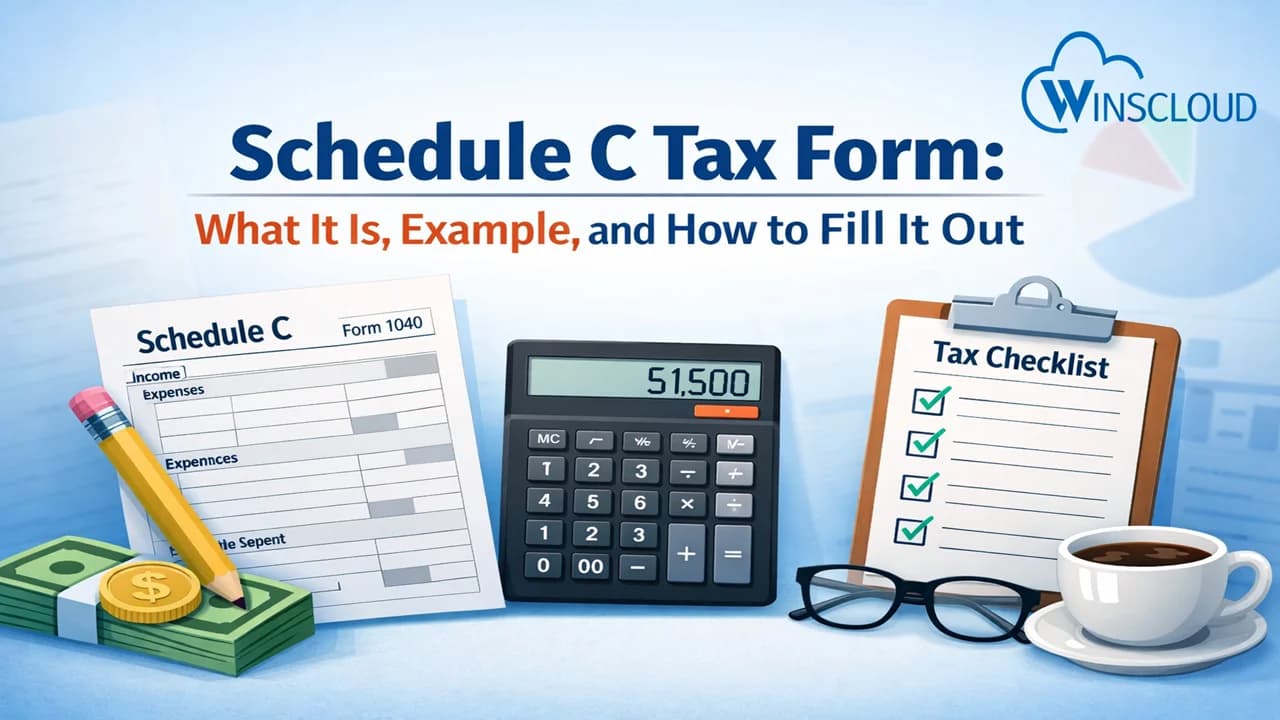
Schedule C Tax Form: What It Is, Example, and How to Fill It Out
If you’re self-employed, a freelancer, or a sole proprietor, the Schedule C tax form is one of the most important documents you’ll file with your federal tax return. This form reports your business income, expenses, and profit or loss to the IRS.
In this guide, you’ll learn what a Schedule C tax form is, who needs to file it, how to fill it out step by step, and see a clear Schedule C tax form example.
What Is a Schedule C Tax Form?
Schedule C (Form 1040) is an IRS tax form 2026 used by sole proprietors and single-member LLCs to report profit or loss from a business.
It is filed along with your individual tax return (Form 1040) and determines:
- Your taxable business income
- Your self-employment tax
- Whether your business made a profit or loss
Who Needs to File Schedule C Tax Form?
You must file a Schedule C if you:
- Are self-employed
- Run a sole proprietorship
- Own a single-member LLC
- Earned $400 or more in net business income
- Worked as a freelancer, consultant, gig worker, or contractor
If you received a 1099-NEC, you likely need to file Schedule C.
What Information Is Reported on Schedule C?
Schedule C reports:
- Business income (gross receipts)
- Returns and allowances
- Cost of goods sold (COGS)
- Ordinary and necessary business expenses
- Net profit or loss
This net profit flows to:
- Schedule 1 (Form 1040) and
- Schedule SE for self-employment tax
Schedule C Tax Form Example
Example Scenario
Name: Alex
Business Type: Freelance Graphic Designer
Gross Income: $60,000
Business Expenses:
- Advertising: $2,000
- Software subscriptions: $1,500
- Home office expenses: $3,000
- Internet & phone: $1,200
- Travel & meals: $800
Total Expenses: $8,500
Schedule C Calculation
| Description | Amount |
|---|---|
| Gross receipts | $60,000 |
| Total expenses | $8,500 |
| Net profit | $51,500 |
Alex reports $51,500 as business income, which is subject to income tax and self-employment tax.
How to Fill Out a Schedule C Tax Form (Step-by-Step)

Part I – Income
- Enter gross receipts (total income earned)
- Subtract returns or refunds
- Add cost of goods sold (if applicable)
- Calculate gross income
Part II – Expenses
List all ordinary and necessary business expenses, including:
- Advertising
- Car and truck expenses
- Office expenses
- Insurance
- Legal and professional services
- Rent
- Utilities
- Travel and meals
- Depreciation
Keep receipts and documentation for every expense.
Part III – Cost of Goods Sold (If Applicable)
Used by businesses that sell physical products Includes:
- Beginning inventory
- Purchases
- Labor
- Materials
- Ending inventory
Part IV – Vehicle Information
Complete this section if you:
- Deduct vehicle expenses
- Use actual expenses or mileage method
Part V – Other Expenses
List any expenses not already included in Part II.
Final Step
- Calculate net profit or loss
- Transfer the amount to Schedule 1 (Form 1040)
- Use Schedule SE to compute self-employment tax
Common Schedule C Tax Deductions
Some of the most claimed deductions include:
- Home office deduction
- Internet and phone
- Business mileage
- Equipment and supplies
- Software and subscriptions
- Marketing and advertising
- Professional fees
Claiming legitimate deductions can significantly reduce your tax liability.
Schedule C vs Schedule C-EZ
| Feature | Schedule C | Schedule C-EZ |
|---|---|---|
| Still in use? | ✅ Yes | ❌ No (discontinued) |
| Expense reporting | Detailed | Simplified |
| Best for | All sole proprietors | Not available now |
The IRS eliminated Schedule C-EZ, so all filers must now use Schedule C.
Common Mistakes to Avoid
- Mixing personal and business expenses
- Forgetting to report 1099 income
- Overstating deductions
- Not keeping receipts
- Missing self-employment tax payments
FAQs About Schedule C Tax Form
What is Schedule C tax form used for?
Schedule C is used to report income, expenses, and net profit or loss from a business operated by a sole proprietor or single-member LLC.
Who needs to file Schedule C?
Anyone who earns self-employment income, including freelancers, contractors, and gig workers, must file Schedule C.
Is Schedule C required for 1099 income?
Yes. If you receive a 1099-NEC, that income must be reported on Schedule C.
How much income requires filing Schedule C?
You must file Schedule C if your net earnings are $400 or more.
Can I deduct business expenses on Schedule C?
Yes. Ordinary and necessary expenses such as advertising, home office, mileage, and software are deductible.
Does Schedule C increase taxes?
Schedule C itself doesn’t increase taxes, but your net profit is subject to income tax and self-employment tax.
What happens if my Schedule C shows a loss?
A business loss may offset other income, potentially reducing your total tax liability.
Can I file Schedule C electronically?
Yes. Schedule C can be e-filed using IRS-approved tax software.
Final Thoughts
The Schedule C tax form is essential for anyone earning self-employment income. Understanding how it works, how to fill it out, and what deductions you can claim can help reduce taxes and avoid IRS issues.
If your business income or expenses are complex, working with a tax professional or using reliable tax software can save time and ensure accuracy.